
The smart home has quietly become one of the most consequential systems in a luxury estate. Get it right and it disappears — lighting scenes match the time of day, shades move on their own, audio follows you room to room, the cinema is one tap from any device, and the network never fails. Get it wrong and you spend the next decade explaining an unruly app on your phone to houseguests.
The difference is design. At The Sanctuary, the preferred integration partner is Peters Audio Video, a firm that specializes in exactly the kind of estate-scale, architecture-first work that this community rewards. The framework below is drawn from their standard playbook.
The Four Layers
A well-designed luxury smart home is really four coordinated systems, running on shared infrastructure.
1. Network
Everything downstream depends on the network. Estate-scale homes require enterprise-grade equipment — a proper router, managed switches, and wireless access points sized for the home's floor plan and construction. Wired backbones (Cat6A minimum) to every AP, every TV, every camera, every audio zone. Fiber runs to the boathouse and detached structures. Redundant internet (fiber primary, LTE or 5G failover) for homes where connectivity is mission-critical.
What this replaces: consumer-grade mesh systems that drop under load, dead zones on the far side of the pool, and the "why is Netflix buffering" call at 8pm on Saturday.
2. Lighting & Shades
Lighting control is the single system that most transforms daily experience. Scene-based control — one tap moves an entire wing from morning to evening — replaces the wall full of switches that plagues most large homes. Motorized shades tie in seamlessly: shades lower for privacy at sunset, raise for morning light on the primary suite, close automatically to protect furniture from harsh afternoon sun on southern exposures.
Dominant platforms at The Sanctuary: Lutron RadioRA 3 or HomeWorks QSX for lighting; Lutron Sivoia for shades; Ketra for tunable white lighting in premium installations.
3. Audio, Video & Cinema
Whole-home audio is the amenity residents use most — every day, in most rooms, at scale that streaming from a single device cannot match. The current standard: architectural in-ceiling speakers in living spaces, kitchens, primary suites, bathrooms, offices, outdoor kitchens, terraces, pool decks, and dockside. Discrete outdoor speakers along walking paths and fire feature areas. Zoned audio with streaming source integration (Sonos, Bluesound, or a dedicated Crestron/Savant/Control4 audio matrix depending on the platform).
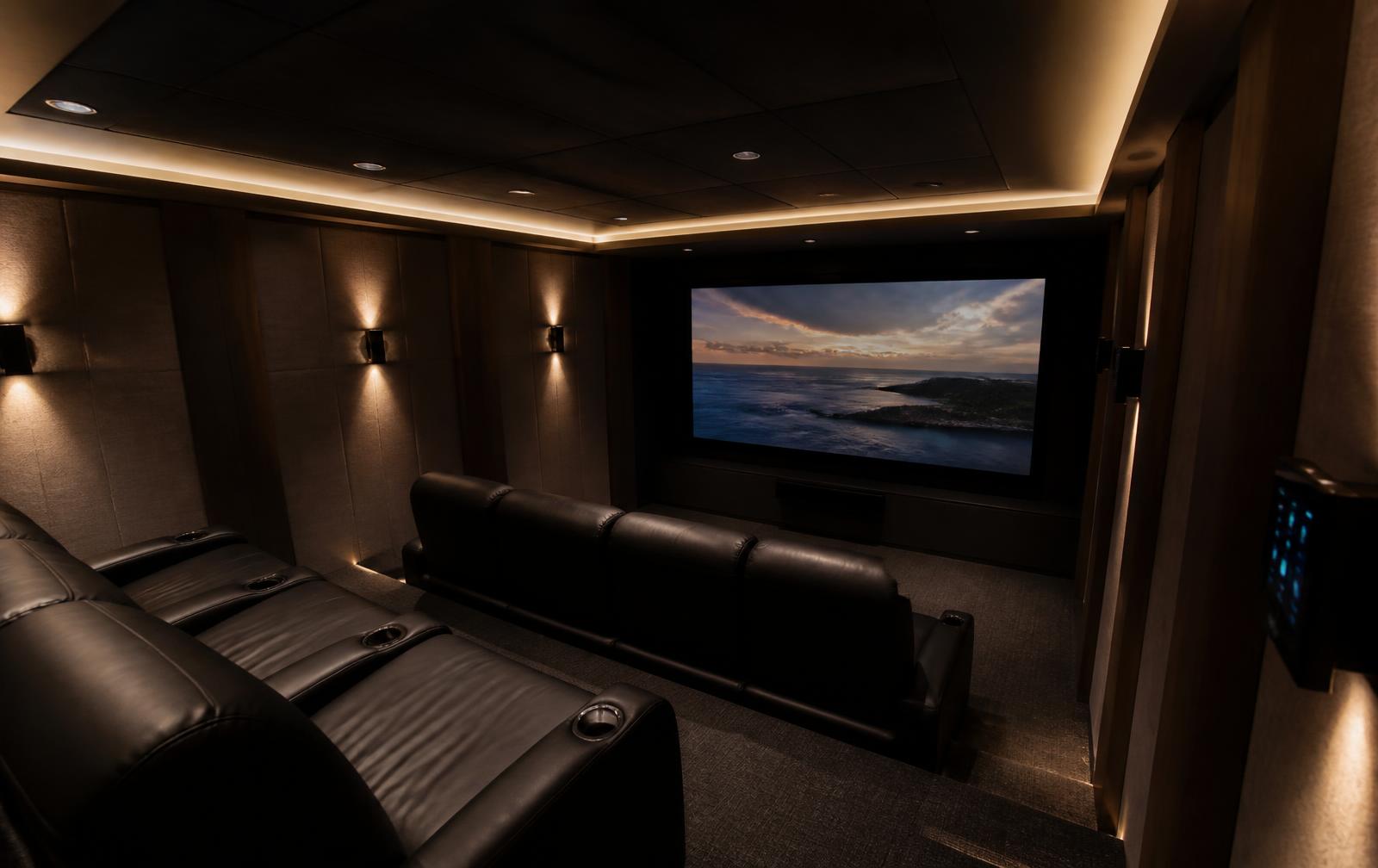
Cinema rooms have evolved. Purpose-built theaters with acoustic treatment, tiered seating, and 4K laser or Sony native-4K projection are common on larger estates. Just as common: media rooms with 85–115 inch OLED or laser TV displays, comfortable modular seating, and integrated sound bars or discrete surround. The right answer depends on how the family actually watches — and how often the room needs to switch between adult evening and kid weekend.
Invisible speakers — Amina, Stealth Acoustics, and their peers — are increasingly specified in primary spaces where clients want zero visible technology.
4. Security, Access, and Environmental
Modern estate security integrates a monitored alarm system, high-resolution IP cameras with edge-based AI recognition (person/vehicle/package alerts, not motion), smart access at every exterior door and gate, and — for larger properties — perimeter beam and camera coverage of the driveway and lake approach. Environmental controls extend the platform: HVAC zoning, smart thermostats, water leak detection, whole-home surge protection, and — critically at this scale — a properly-sized generator with automatic transfer, keyed to the home's essential loads.
What This Costs — and Why
Smart home budgets scale with home size, program complexity, and platform choice. For a typical 6,000–10,000 sf Sanctuary estate, the fully-integrated technology package (network, lighting, shades, audio, cinema, security, environmental) is a meaningful line item — but one that pays back daily in usability and monthly in operational reliability. The most expensive mistake is under-specifying during construction and retrofitting the difference later.
The Best Time to Design Your Smart Home
Rough-in. Full stop. The single biggest determinant of smart home outcome is whether the low-voltage system is designed and pre-wired during framing — before drywall — with the same rigor as electrical and plumbing. Peters Audio Video is engaged during rough-in on the majority of their Sanctuary projects for exactly this reason. Retrofits are possible; well-designed retrofits are rare and expensive.
The Retrofit Path
For existing Sanctuary homes, a phased retrofit is the practical approach: network first (biggest single quality-of-life improvement), lighting control second (biggest daily-use improvement), shades and audio in the phases that follow. Wireless-capable platforms — Lutron RadioRA, for instance — make lighting retrofits meaningfully less invasive than they were a decade ago.
Wellness and the Emerging Frontier
Circadian lighting (Ketra and its peers) that tracks color temperature through the day. Water filtration and structured water systems. Air quality monitoring and whole-home filtration. Sauna and cold-plunge integration with mobile controls. These are the emerging edges of the luxury smart home, and they show up increasingly in Sanctuary specifications.