
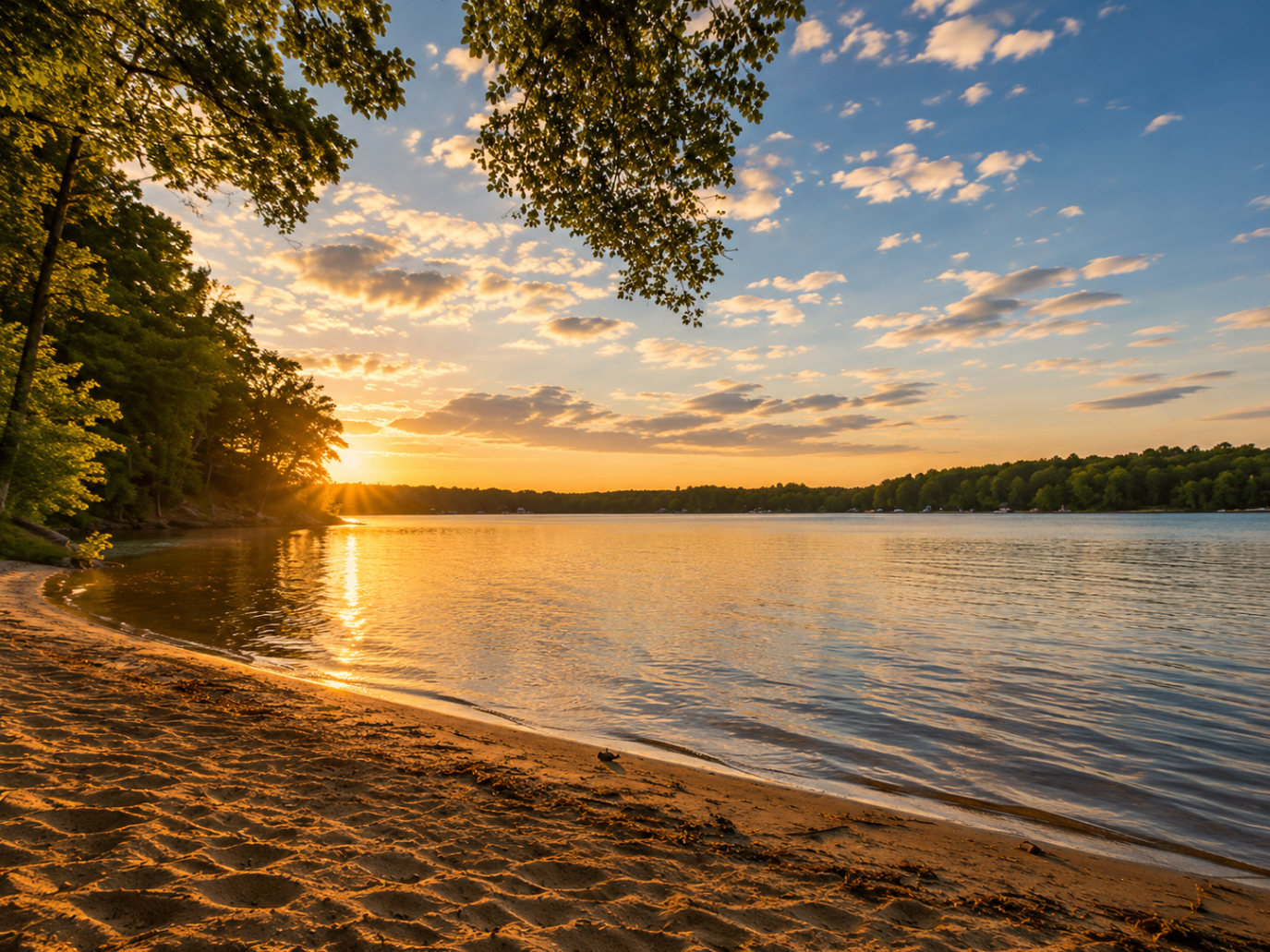
Every luxury community has amenities. Very few have this one. The Sanctuary was master-planned around a conservation covenant that set aside about 300 of its 1,350 acres as common open space — protected from development, retained in a near-natural state, and made accessible to residents through a growing network of walking trails. Two decades in, that covenant has held, the canopy has matured, and the preserve is arguably the community's most valuable amenity.
You feel it immediately. The Sanctuary is not a landscaped community. There are no mowed medians, no manicured entry berms, no ornamental plantings pretending to be forest. The forest is the forest. Homes are sited within it — carefully, with substantial tree save requirements — and the negative space between homes is not lawn but understory.
What the Preserve Contains
The Sanctuary's preserve is a mixed hardwood forest typical of the western Piedmont: white oak, red oak, tulip poplar, hickory, dogwood, sourwood, sweetgum, and beech across the ridges, with river birch, sycamore, and red maple in the drainage bottoms. Understory includes mountain laurel, native azalea, and a dense fern layer in the shaded coves. Wildflower bloom runs March through October, with trillium and mayapple in spring and asters into fall.
The preserve is not gardened. It is managed lightly for invasive species control, storm damage, and trail maintenance — but otherwise left to itself. That is, deliberately, the point.
Wildlife
Because the preserve is contiguous and buffered from major roads, wildlife populations are healthy and visible. What residents regularly report seeing:
- White-tailed deer — resident population; often bedded in the understory near dawn and dusk
- Wild turkey — flocks of 15–20 birds work the ridges through fall and winter
- Red-tailed hawk, barred owl, great horned owl — nesting pairs throughout the preserve
- Great blue heron, belted kingfisher, osprey — along the shoreline year-round
- Bald eagle — increasingly common sightings on Lake Wylie
- Red fox, gray fox, coyote — present but rarely seen
- Migratory songbirds — spring warbler migration is notable; the community sits along a minor Atlantic flyway corridor
The Trail System
More than eight miles of walking trails traverse the preserve, ranging from wide crushed-stone paths suitable for strollers and casual walking to single-track natural-surface trails along the ridges. Trails are marked, mapped, and maintained by the community. Interior loops connect estate neighborhoods to Camp Sanctuary; shoreline segments follow the Lake Wylie edge through preserved forest.
Residents typically use the trails for morning walks, dog exercise, running, and — in the cooler months — evening strolls after dinner. The trails see very little bicycle traffic, which is a deliberate community choice to preserve the walking character.
The Conservation Ethic in Practice
The preserve is protected by a combination of deed restrictions, HOA covenants, and — critically — the practical geography of the community's build-out. Additional development within the designated preserve is not merely disallowed by covenant; there is no infrastructure to support it. Roads, utilities, and drainage were engineered around the preserve boundaries from the beginning. That structural commitment is what distinguishes The Sanctuary from communities that "preserve open space" through easements that can be adjusted over time.
Individual homesites carry their own tree save requirements. Community architectural review evaluates tree removal on every construction submittal, and specimen trees within building envelopes are typically retained where site engineering allows.
Why This Matters for a Luxury Community
The most enduring luxury asset a community can offer is not a clubhouse — clubhouses can be renovated in a season, and often are. It is mature, protected land. The Sanctuary understood that at its founding, and the compounding value of that decision is on display now, two decades on. Homes sit in a forest that reads, visually and acoustically, closer to a private nature preserve than a suburb.
For buyers relocating from denser markets, this is often the moment during a tour when the community becomes memorable — when they realize that the trees are not decorative, that the quiet is genuine, and that both are guaranteed to remain.