
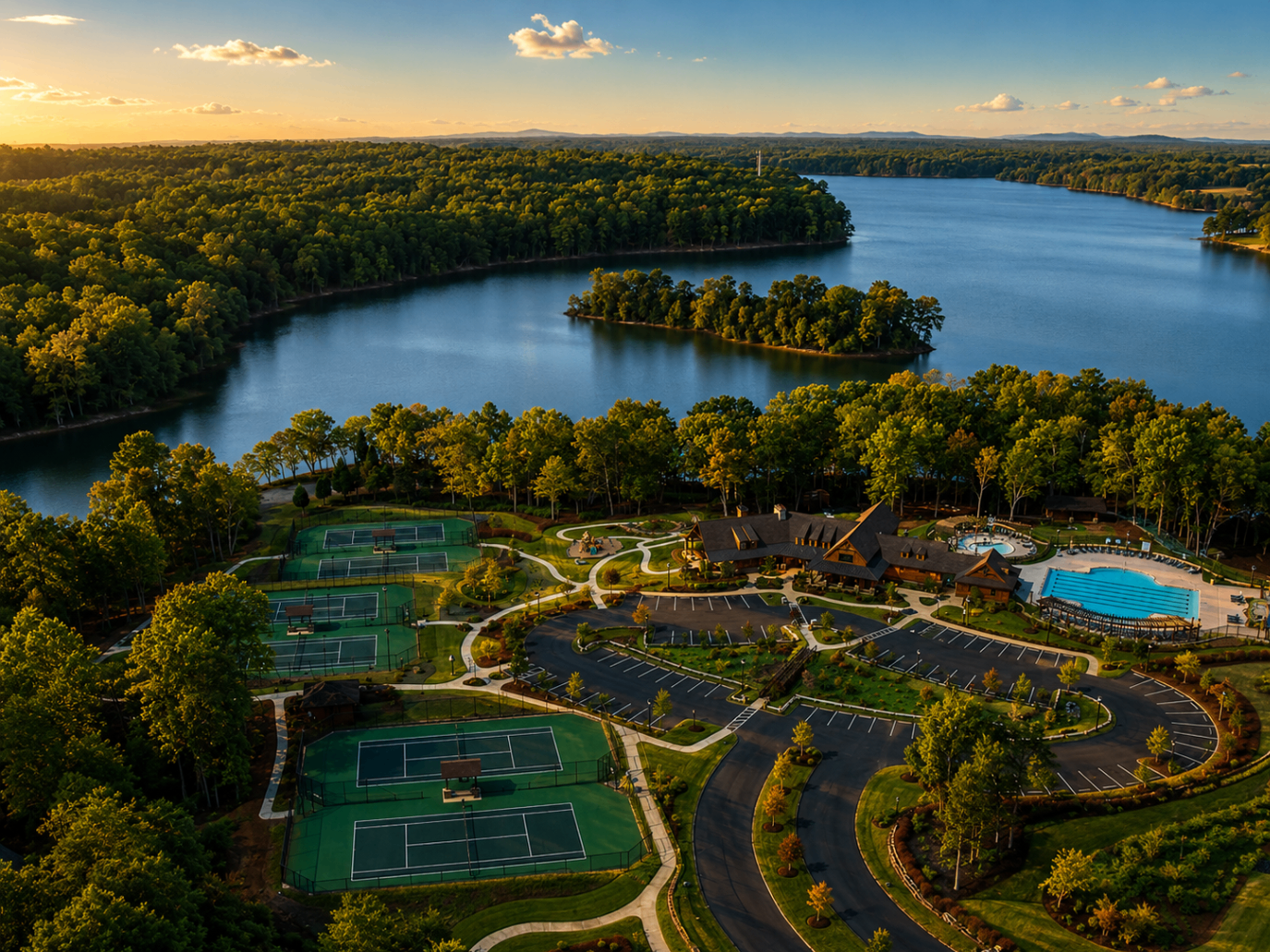
The Sanctuary occupies roughly 1,350 acres along the Charlotte shore of Lake Wylie, on the Charlotte side of the North Carolina–South Carolina line. It is one of a handful of Carolina communities whose entire premise begins with the land rather than the lot count — about 300 acres were set aside as common open space, fewer than 200 homesites were laid out across the rest, and 22 miles of trail tie it together.
From the entrance, a winding parkway climbs through hardwood forest to reveal estate homesites arranged among coves, ridges, and glens. Streets are cul-de-sac quiet. Docks are private. The community's central amenity village — Camp Sanctuary — sits deep within the property, invisible from the road, feeling more like a lake camp than a country club.
The Founding Idea
The Sanctuary was master-planned around a straightforward conservation covenant: hold large tracts as common open space, protect the shoreline, cluster homesites where trees allow, and let architecture answer to topography rather than the other way around. The result is a density that reads closer to a wilderness enclave than a subdivision — homesites run from about two to more than 13 acres, and interior lots are buffered by hundreds of feet of understory.
That founding idea has aged well. Two decades on, mature canopy has grown in around even the newest phases. Trail systems have expanded. The shoreline retains its natural edge. And The Sanctuary is now widely regarded as one of the most prestigious luxury communities in the Carolinas, alongside Longview, The Palisades, Ballantyne Country Club, and Providence Country Club — while remaining distinctly its own thing.
What Makes It Different
Every Charlotte-area luxury community has a story. The Sanctuary's story is the land itself. Prospective buyers who tour multiple neighborhoods often describe the same first impression: that The Sanctuary feels quieter, older, and more private than communities half its age. That is a function of three deliberate choices.
The preserve. About 300 acres are held as common open space. Trails, wildlife corridors, and buffered creek beds are shared community assets, not the leftovers of platting.
The shoreline. The Sanctuary maintains one of the longest stretches of privately-held Lake Wylie shoreline in the region. Boat docks are permitted on waterfront lots per Duke Energy shoreline management guidelines; interior residents access the lake through community launches at Camp Sanctuary.
The architecture. The community's design guidelines favor materials and forms that recede into the landscape — cedar, stone, board-and-batten, standing-seam metal, deep porches, generous glazing. Homes here rarely fight the trees. They lean on them.
Who Lives Here
Residents are drawn from Charlotte's executive, financial, medical, and legal communities, alongside a growing number of relocating families from the Northeast, Florida, and the West Coast. Second-home ownership is meaningful but not dominant. The community skews toward established households — many with school-age children — who choose The Sanctuary for exactly what the name implies: a refuge that is nonetheless twenty minutes from SouthPark, Uptown, or Charlotte Douglas International.
Access, Location, and Getting Around
The Sanctuary sits along Youngblood Road with primary access via NC-49 and I-485. Distances residents talk about:
- Charlotte Douglas International (CLT): approximately 18 miles / 25 minutes
- Uptown Charlotte: about 14 miles, per the association — roughly 25–35 minutes depending on traffic
- SouthPark: approximately 17 miles / 25 minutes
- Rivergate shopping: approximately 4 miles / 8 minutes
- Ballantyne: approximately 13 miles / 20 minutes
What This Guide Covers
This site is an independent editorial reference. Elsewhere on the guide you will find deep dives into Lake Wylie living, the preserve and its wildlife, Camp Sanctuary's amenities, the range of estate homesites, the architectural vocabulary of the community, the process of building a custom home here, interior design informed by the setting, and how residents integrate smart home technology into estate-scale properties.
You will also find neighborhood comparisons that place The Sanctuary in context — how it differs from Ballantyne Country Club, Longview, The Palisades, and other Charlotte enclaves — and a growing journal of market notes, home tours, and seasonal observations from within the community.